
94% of founders and revenue leaders expressly stated that it’s not possible to achieve Series B if the company has a disregard for metrics. This sentiment was further validated by the VCs.
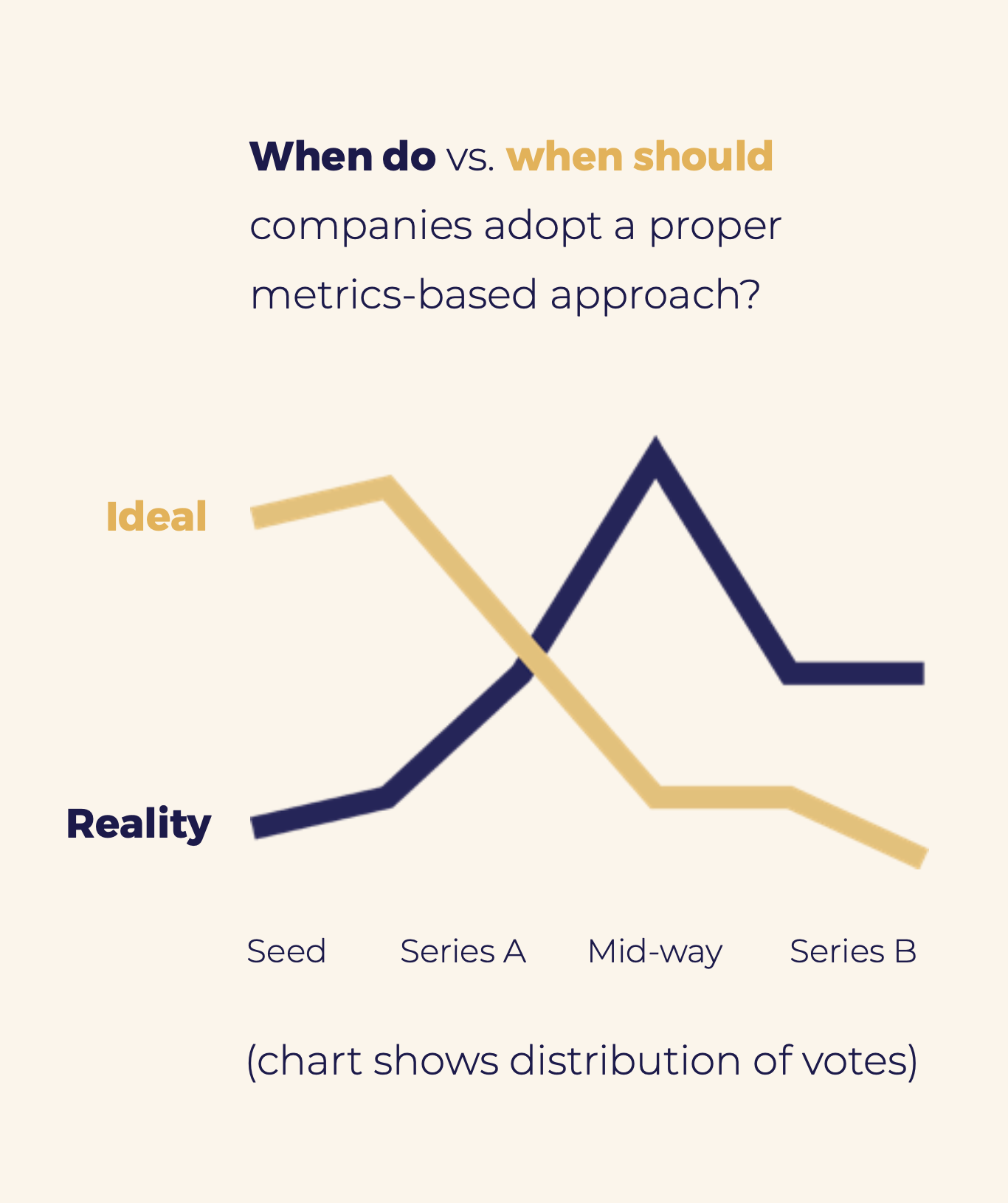
Our research suggests that, despite this, companies are sluggish in their adoption of a metrics-based approach.
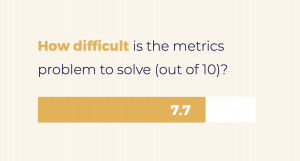
However, the good news is that despite founders, revenue leaders, and VCs ranking the metrics problem as the single most important problem requiring focus, they also said that it’s not impossible to solve.
“Between Series A and B, there is a huge leap required in the level of numerical sophistication, thinking about data and process. Series A investors can be very flexible, but Series B investors look at the model and the numbers much more than the team – there’s a big difference. So if your numbers don’t tell the right story it gets tricky.”VC Notion, ~Episode 1
 Though metrics are part of the (wider) story that needs crafting for the Series B investors, the scaling issue, which we learn later is most fundamentally about repeatability, is essentially formulaic. Moreover, the refinement of any formula starts with the result (then you work backwards). Metrics present this result. In other words, the investor presentation is half the story, the other half is about following a practical formula to improve performance.
“As soon as you are investing resources (time or money) you have to start tracking metrics as early as possible because 1) investors love to see it, 2) it’s going to guide you on updating your strategy, and 3) once you start to layer in more people and resources into your process those metrics are going to inform what behaviours [tactics] you need to implement.”F/RL Yarbrough, ~Davies, ~Miller
Key insights
Full adoption of a metrics-based approach is nearly always required well before raising Series B and founders, revenue leaders and VCs generally agree that companies should start as soon as possible.
VCs look for repeatability for investing at Series B and performance metrics provide the most reliable headline method of demonstrating this.
The extent or depth of performance metrics should match the maturity of the business, so start off with the outline metrics and add in more granular measures over time.
The most common blend of metrics to describe headline performance, sales efficiency and product-market fit are detailed on page 10.
Metrics allow managers to objectively measure performance within their team, particularly funnel metrics, and identify specific areas of the business that need attention.
Metrics also help leaders get an early warning and troubleshoot issues that can lead to the stuttering of growth that often happens shortly after raising Series A.
By removing the subjectivity around the measurement of performance, a metrics-based approach helps founders and leaders guard and justify investment within the business.
An experienced revenue leader is likely to know how best to establish a proper metrics-based approach. Scalewise has a community of Scale Experts who are available to help.